Growing Region Flavor Map — Dominican Republic & Nicaragua
The Cuba chapter established a coordinate system for reading cigar leaf: Terroir → Field Physiology & Chemical Precursors → Leaf Position & Use (Wrapper / Binder / Filler) → Curing, Fermentation & Aging → Style Tendencies Perceivable by the Senses. If a map has only one origin point, the "orthodox myth" can still absorb all attention.
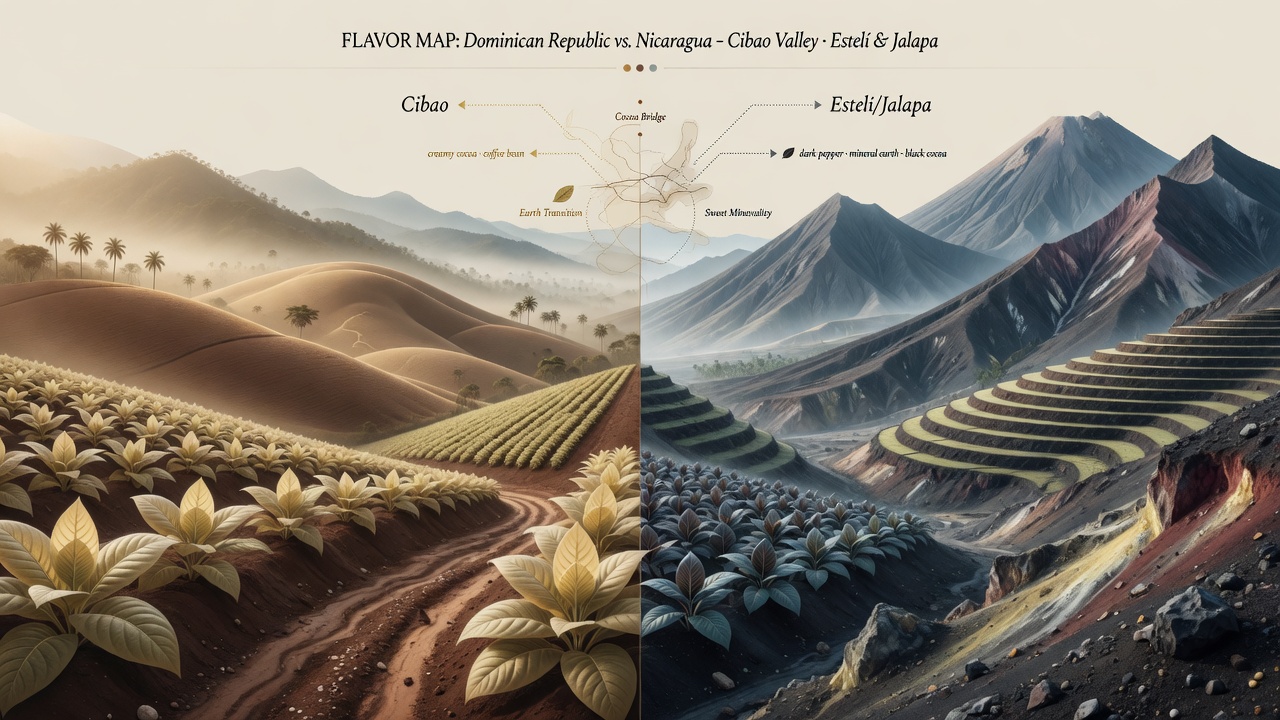
This chapter turns the lens toward the pair of names most frequently juxtaposed in the global non-Cuban handmade cigar world: the Dominican Republic and Nicaragua. In popular discourse, they are often compressed into a catchphrase —
- Dominican: smoother, sweeter, more approachable;
- Nicaraguan: stronger, more peppery and earthy, more "structured".
Half of this statement is industry consensus on tendencies; the other half is market labeling. Only by unpacking it can we see where the differences come from, how much trust they deserve, and where year, field plot, leaf position, and blend can completely rewrite them.
1. Three Reading Boundaries (Continuation)
- Regional flavor is a tendency description, not an ID card.
Different valleys in the same country, different fields in the same valley, different years and leaf positions in the same field — the results can differ enormously. "Smoother" and "stronger" below are statistical style dictionaries, not contractual terms.
- This article primarily discusses air-cured cigar tobacco logic.
It does not apply to flue-cured Virginia, burley, or oriental tobacco systems. The reputation of the Dominican Republic and Nicaragua in popular culture is firmly tied to whole-leaf handmade cigar raw materials and rolling narratives.
- Knowing regions ≠ picking a "better-tasting" smoke.
All combustible tobacco products produce tar, carbon monoxide, multiple carcinogens, and irritating gases. Educating about terroir does not change health risk facts, nor does it constitute encouragement to consume.
2. Why Pair These Two Countries on the Same Map
| Dimension | Dominican Republic | Nicaragua | Comparative Value |
|---|---|---|---|
| Global Position | Eastern side of Hispaniola, Caribbean; long-established cigar material and rolling center | Central America; frequent coordinate for contemporary handmade cigar strength and "full-origin narrative" | Island vs. continental ecological context |
| Popular Default Label | Balanced, creamy/cocoa, approachable, all-day smoke narrative | Strong, peppery, earthy, dark cocoa, high satisfaction narrative | The most common "sweet-smooth vs. bold-structured" binary |
| Industry Reality | Mature blend culture: local filler/binder + large-scale imported wrappers (Cameroon, Ecuador, Indonesia, CT USA, etc.) | Estelí and other regions produce both filler and high-quality wrapper; "all-Nicaraguan" blends are common | Style comes half from leaf, half from blending habits |
| Relation to Cuba | Often positioned as "approachable entry outside the Cuban narrative" | Often positioned as "non-Cuban line closest to strength and spice structure" | Second and third anchor points on the series map |
Binding these two countries together is not because they "share one flavor," but because readers almost always use them as yardsticks for each other — to use a yardstick well, you must first admit both sides are moving.
3. Quick Overview: Default Labels and Their Limits
In industry and tasting discourse, Dominican leaf (especially the Cibao narrative) is often described as:
- Medium or medium-plus body, extreme throat-hit sensations are relatively less common (still depends on ligero ratio and fermentation);
- Sweetness and roundness are more readily perceived: cream, milk chocolate, coffee, nuts, light caramel;
- Spice exists, but tends to be more integrated, pepper can be present but is less often described as a piercing note throughout;
- Oiliness and smoothness, when emphasized, often correspond to good processing and aging, not "naturally zero irritation."
Limitation: The Dominican Republic also produces high-proportion strong filler and dark wrapper blends; "necessarily mild" is a market simplification, not an agronomic conclusion.
- Strength and structure are more often pushed to the forefront: smoke density, satisfaction, lingering finish;
- Black pepper, red pepper, earth, minerals, dark cocoa, roasted coffee, wood — high-frequency terms;
- Jalapa and other sub-regions are separately labeled as "sweeter, finer, brighter" — demonstrating that a full spectrum exists within one country;
- Volcanic ash soils + intense sunlight and elevation gradients in some regions are often used to explain "why it's strong, why the aroma is bold."
Limitation: Good fermentation and high proportions of volado/seco can still produce relatively mild Nicaraguan tobacco; "necessarily strong" is equally a label.
Dominican approachability ≈ valley humid-wet rhythm + relatively alluvial/loamy management + a ferment and blend culture leaning toward "integration" Nicaraguan boldness ≈ volcanic ash background + light/temperature and partial high-elevation microclimates + variety/site selection and fermentation strategies that more often retain strength and spice precursors
Now unfolded country by country, then converging into a summary table of causes.
4. Dominican Republic Flavor Map
The Dominican Republic is located in the Caribbean, with a tropical maritime climate and relatively distinct wet and dry seasons. The most critical narrative for cigar tobacco concentrates around the northern Cibao Valley:
- Warm, high humidity, conducive to leaf area expansion and biomass formation;
- Wet-dry rhythm provides a predictable agricultural calendar for ripening and curing windows;
- Valley micro-topography and river-alluvial-related loamy, well-drained fields have long been considered the core of premium tobacco field narratives (field-level variation is immense — avoid painting the entire country as one soil type).
Similar to western Cuba's "tropical + wet-dry" island ecological framework, but industrial trajectory and market blending culture have taken a different path over the past decades: deeper integration into North American and European non-Cuban cigar supply chains, highly concentrated rolling centers, and extremely rich brand and factory ecosystems.
| Regional Narrative | Common Positioning | Note When Reading |
|---|---|---|
| Cibao Valley | National core cigar zone; balanced, sweet, structured mainstream dictionary largely originates here | "Cibao" itself is still a large area; fields and years can vary enormously |
| Yamasá etc. | Appear in raw material introductions as specific farms/sub-regions | Useful for understanding "sub-coordinates within a country," don't memorize as the only correct answer |
| La Canela etc. | Mostly tied to specific estates or well-known blend materials | Belongs to brand and plot story layer, needs separation from general valley tendencies |
Lesser regions and experimental fields need not be covered evenly in an educational article: grasp Cibao as the default anchor, then acknowledge sub-region spectra — that suffices to build the map.
In Dominican premium field narratives, alluvial or fine loamy soils with some balance of water retention and drainage are commonly described. The mechanism worth remembering is:
- Available nitrogen is still the master switch: nitrogen on the high side → nicotine and total nitrogen tend to rise → body and irritation increase, sweetness tends to decline;
- Well-managed valley tobacco is more easily processed toward balanced sugar-nicotine, suppressed irritation, perceptible sweetness and oiliness;
- Soil does not directly "create creaminess"; cream, cocoa, and other descriptors are the sensory result of field precursors + curing and fermentation + wrapper blend working together.
Cigar structure review (consistent with the Cuba chapter):
- Wrapper (Capa): Appearance, combustion, and a large portion of first-impression aroma;
- Binder (Capote): Structure and combustion assistance;
- Filler (Tripa): Body, main flavor, and satisfaction.
A notable characteristic of the Dominican industry: local supply of quality filler and binder, alongside substantial use of imported wrappers — Cameroon (fine spice), Ecuador-grown Connecticut shade or Sumatra types (relatively smooth, layered aroma), Indonesian wrappers, Connecticut USA, etc., are all common puzzle pieces.
So when you say "this Dominican is creamy," the questions to ask are:
- Is the filler primarily Cibao and other local leaf? How high is the ligero (upper strong leaf) ratio?
- Where does the wrapper come from? Many "first impressions" are actually the wrapper speaking;
- Has fermentation and aging suppressed the vegetative harshness and sharp irritation?
Dominican "approachability" is often the product of raw material potential × imported wrapper choice × a blending and aging culture leaning toward "integration" — not valley air infused with condensed milk.
| Dimension | Common Description Tendency | Easy to Misread |
|---|---|---|
| Body | Medium as mainstream, can go up or down | High ligero blends can be very strong |
| Sweetness | Cream, cocoa, light caramel, nuts | Sweet ≠ low hazard; also ≠ low nicotine |
| Spice | White pepper, mild spice, often more integrated | With Cameroon wrapper, spice can rise noticeably |
| Roast | Coffee, cocoa, toast | Strongly correlated with fermentation depth |
| Finish | Relatively clean, medium length, positive tendency narrative | Year and burn quality heavily influence it |
| Mouthfeel | Roundness, smoothness emphasized | Poor processing still yields rough, bitter notes |
5. Nicaragua Flavor Map
Nicaragua is located in Central America, with cigar core zones concentrated in the northern highlands and valleys (Estelí, Condega, Jalapa, etc.). Compared to the Caribbean island narrative, what is more often discussed here:
- Distinct wet and dry seasons with stronger sunlight;
- Elevation and valley microclimate differences (within one country, one can go from relatively hot basins to cooler valleys with different diurnal temperature ranges);
- Soil narratives tied to volcanic activity background (volcanic ash soil) — this is the layer most frequently cited, and most in need of restrained expression, when explaining "why Nicaragua is often described as bold."
| Region | Common Style Narrative | Key Mechanism Reading Points |
|---|---|---|
| Estelí | Power, black pepper, earth, dark cocoa, bold structure; the "default capital" of national strength | Light-temperature conditions + soil and cultivation management + large concentration of strong filler and dark wrapper industries jointly shape the label |
| Jalapa | Relatively sweeter, more refined, brighter aroma, pepper less "biting" | Valley microclimate (often described as relatively cooler, conditions favoring aromatic detail) creates a softening contrast within one country |
| Condega | Between Estelí's power and Jalapa's refinement | Useful for understanding the middle band of the spectrum, not a "third place medal" |
Ometepe and other island/volcanic-perimeter regions appear occasionally in specialty material stories; on an educational map, note them briefly: they enrich "Nicaragua has more than one flavor," not equal page allocation.
Industry rhetoric likes to say: "Nicaragua's volcanic ash soil brings minerality and power." A more responsible formulation:
| Discussable | Caution Required |
|---|---|
| Volcanic ash soils often have unique mineral backgrounds, structure, and water retention/drainage characteristics affecting root environment and nutrient availability | Directly stating "pepper molecules come from the soil" |
| Combined with nitrogen, potassium, and other management, they can influence nicotine, body (thickness and oil), and secondary metabolite intensity | Attributing all boldness to volcanoes while ignoring variety, position, and fermentation |
| Minerality and earthiness are high-frequency sensory labels deeply tied to regional narratives | Treating labels as lab fingerprints for every leaf |
Soil modifies metabolism through nutrient and water rhythms; the pepper and earth on the palate are the integrated impression of metabolites + processing + combustion.
Central American cigar regions widely grow and breed Criollo, Corojo, and their numerous derivatives (naming systems vary by farm). At the popular-science level, one needs only grasp:
- Cuban germplasm historically flowed out and underwent local domestication, giving Dominican, Nicaraguan, Honduran, etc., a shared thread of "Cuban lineage," but decades of selection have formed local pedigrees;
- Under strong light, specific soils, and high-position harvests, certain lines are more prone to high body, high alkaloid potential, and pronounced spice precursors — Estelí's "boldness" partly comes from this variety × environment × position combination, not border magic;
- The Dominican Republic also uses Criollo/Corojo-related materials; the difference between the two countries cannot be simplified to "one seed vs. another seed."
| Dimension | Estelí Tendency | Jalapa Tendency (Comparative) |
|---|---|---|
| Body | Medium-high to high more common | Medium to medium-high, edge often more restrained |
| Spice | Black pepper, red pepper, pungent structural notes | Pepper finer, more integrated, or leaning toward spice sweetness |
| Earth/Mineral | Pronounced | Relatively subdued or cleaner |
| Sweetness | Dark cocoa, dark chocolate, roasted | Brighter sweetness, nuts, lighter cream narratives more common |
| Finish | Long, with lingering spice aftertaste | Relatively elegant, clean |
| Overall Impression | Bold, intense, strong structure | Refined, clear, still retaining Nicaraguan backbone |
All-Nicaraguan blends (wrapper, binder, filler all from the country) push the above dictionary "purer"; once wrappers or fillers from other countries enter, the spectrum shifts immediately — when reading a region, read the blend sheet, not just the flag.
6. Summary Table of Differences: Terroir × Craft × Industry Culture
| Causal Layer | Dominican Republic More Common Direction | Nicaragua More Common Direction | How to Understand the Difference |
|---|---|---|---|
| Macro-geography | Caribbean island, tropical maritime climate | Central American mainland, northern highlands/valley groups | Light/temperature, elevation gradient, air mass paths differ |
| Microclimate | Cibao Valley humid-wet and wet-dry rhythm | Estelí/Jalapa/Condega elevation and valley differences are significant | Nicaragua's domestic spectrum is often more "dramatic" |
| Soil Narrative | Alluvial/loamy, drainage and fertility balance | Volcanic ash + mineral background emphasized | Both act through nitrogen, water, potassium, and root environment, not as flavoring agents |
| Variety and Breeding | Criollo/Corojo local paths + blend diversity | Same broad lineage, but high-light, high-body direction expression often strengthened | Difference is "expression and choice," not a simple seed binary |
| Position Strategy | Balanced liga more common in approachable-positioned products | High ligero proportion more common in strength-oriented products | Changing position within the same region is more effective than changing passports |
| Fermentation | Often pursues integration, smoothness, irritation reduction serving "approachability" | Strategies that retain strength and spice structure are equally mature | Fermentation is an amplifier, but can also be a softener |
| Wrapper Habit | High imported wrapper ratio, first impression often rewritten by wrapper | Domestic dark/high-oil wrapper narrative strong, "all-Nic" purity high | When reading a cigar, first clarify wrapper origin |
| Market Culture | North American daily smoking, gifts, and "entry to advanced" broad spectrum | Strength enthusiasts, concentration and pepper structure enthusiasts narrative strong | Demand shapes growing and blending, not just terroir one-way determination |
One-sentence summary:
Dominican roundness is the high-frequency result of ecological potential fully utilized by an "integration-oriented" processing and blend culture; Nicaraguan boldness is the high-frequency result of volcanic ash and light-temperature backgrounds where variety—position—fermentation choices more often push strength and spice to the forefront. Both sides have counter-samples; the map draws the peaks, not every grain of sand.
7. Cross-Flavor Dimension Comparison (Appreciation Coordinates, Not Rankings)
| Sensory Dimension | Dominican Tendency | Nicaraguan Tendency | Cuba Quick Reference (for series continuity) |
|---|---|---|---|
| Body | Medium spectrum mostly | Medium-high spectrum more common | Complete structure, body can be high |
| Sweetness | Cream, milk chocolate, nuts | Dark cocoa, roasted, Jalapa can be brighter | Sweetness present but often yields to spice-earth structure |
| Pepper/Spice | Present, often more integrated | Black pepper structural strength (Estelí) | Spice + earth classic dictionary |
| Earth/Mineral | Medium or subdued narrative | Pronounced | Pronounced |
| Coffee/Cocoa | Light to medium roast feeling common | Dark roast, dark chocolate more | Coffee cocoa + leather wood common |
| Wood/Leather | Can be present, not always dominant | Common supporting term | High frequency |
| Oil/Smoothness | Emphasized as approachability advantage | Can have heavy oiliness, smoothness depends on fermentation | Oil and structure both matter |
| Finish | Medium positive, clean narrative | Long, with spice aftertaste | Long and layered |
| Typical Misread | "Definitely mild, definitely sweet" | "Definitely strong, definitely bitter" | "Definitely the most authentic" |
8. How to Read "Dominican Narrative" and "Nicaraguan Narrative"
Below is an appreciation framework, not a tasting tutorial, nor encouragement to use tobacco products. When reading reviews or raw material introductions, use this checklist for structural understanding.
- Wrapper origin and color: Often determines front-half aroma and burn appearance.
- Filler three-country/three-region ratio: Is it "all-Dominican," "all-Nicaraguan," or a blend?
- Strength rating and ligero logic: High-stem leaf ratio often predicts body better than the passport.
- Fermentation and aging statement: Long aging narratives typically point to the possibility (not guarantee) of reduced irritation and increased roundness.
- Approachable, balanced, creamy, cocoa, coffee, nuts, all-day, smooth;
- Ask: does approachability come from valley leaf itself, or imported wrapper + fermentation?
- Beware: using "Dominican" as a substitute for specific region and blend.
- Power, pepper, earth, dark chocolate, intense, all-Nicaraguan;
- Ask: is Estelí filler dominant, or does Jalapa lift sweetness and refinement?
- Beware: ignoring Condega/Jalapa's refined samples, retaining only the Estelí stereotype.
The industry broadly categorizes filler into relatively mild volado, medium seco, and stronger ligero (naming systems vary by factory). All three countries can produce a spectrum from mild to intense; region merely shifts the center point of the spectrum, not locking either end.
9. Common Misconceptions
- "Dominican is always mild, Nicaraguan is always strong."
Wrong. Position, fermentation, and blend can overturn the impression. Region provides prior probability, not a verdict.
- "One country, one flavor."
Wrong. Jalapa vs. Estelí, different Cibao fields — all are within-country spectra. The series maps the peaks.
- "Stronger = better / more authentic."
Wrong. Strength is an intensity dimension, not a quality or moral dimension. Quality depends on burn, off-notes, completeness, and consistency; health-wise, it is the combustion itself that carries risk, not how strong it is.
- "Region = quality guarantee."
Wrong. Poor farming, failed processing, mold damage, combustion issues — these can ruin any passport.
- "Volcanic ash soil directly equals pepper flavor."
Oversimplification. Soil influences metabolism and body; pepper is a composite sensory label.
- "A Dominican with imported wrapper is not truly Dominican."
Dogmatic. Industry reality is blending; read blend honesty, not imagined blood purity.
- "Knowing regions helps pick safer smokes."
Dangerously misleading. There is no safe combustible tobacco region.
10. Health Notice
- Cigars, cigarettes, and other combustible tobacco products generate numerous harmful substances during consumption, including but not limited to carbon monoxide, polycyclic aromatic hydrocarbons, nitrosamines, irritant aldehydes, and fine particulate matter.
- Regional flavor education belongs to agricultural and cultural knowledge; it does not constitute a usage recommendation, nor does it reduce health risk.
- For those already dependent on nicotine, quitting and professional medical support (including nicotine replacement therapy as prescribed) are the effective paths to risk reduction; using "changing regions, brands, or strengths" as a substitute for quitting is common self-deception.
- Secondhand smoke is equally harmful to others in the same environment; indoor tobacco combustion has no "premium region exemption."
11. Series Preview and Conclusion
This chapter advances the "Growing Region Flavor Map" to its second station: the dual-peak comparison of the Dominican Republic and Nicaragua.
- Dominican Republic: anchored by the Cibao Caribbean valley narrative; approachability, creamy cocoa, and integrated spice are the high-frequency dictionary; the highly developed rolling industry and imported wrapper blending mean the "flag flavor" must be read together with the blend sheet.
- Nicaragua: anchored by the Estelí / Jalapa / Condega triangle of the Central American spectrum; volcanic ash and light-temperature background yield power, pepper, and earth as the high-frequency dictionary; the country already possesses a complete gradient from bold to refined.
- The differences come from climate and soil + elevation microclimate + variety and position selection + processing and fermentation strategy + market blend culture — not a mysterious line on the border.
Future maps can continue to unfold:
- Honduras: another Central American power and earth narrative often compared to Nicaragua;
- Brazil, Colombia, and other South American filler and specialty leaf;
- Ecuador, Cameroon, Indonesia, Connecticut USA, and other wrapper-dedicated coordinate systems;
- And the boundary logic between Chinese flue-cured/sun-cured regions and cigar leaf.
Reading regions is about having a little less myth and a little more mechanism. Flavors can have a map; combustion risks have no tax-free zone.
This article is a raw material and regional educational piece, not a purchase or consumption recommendation for any tobacco product.